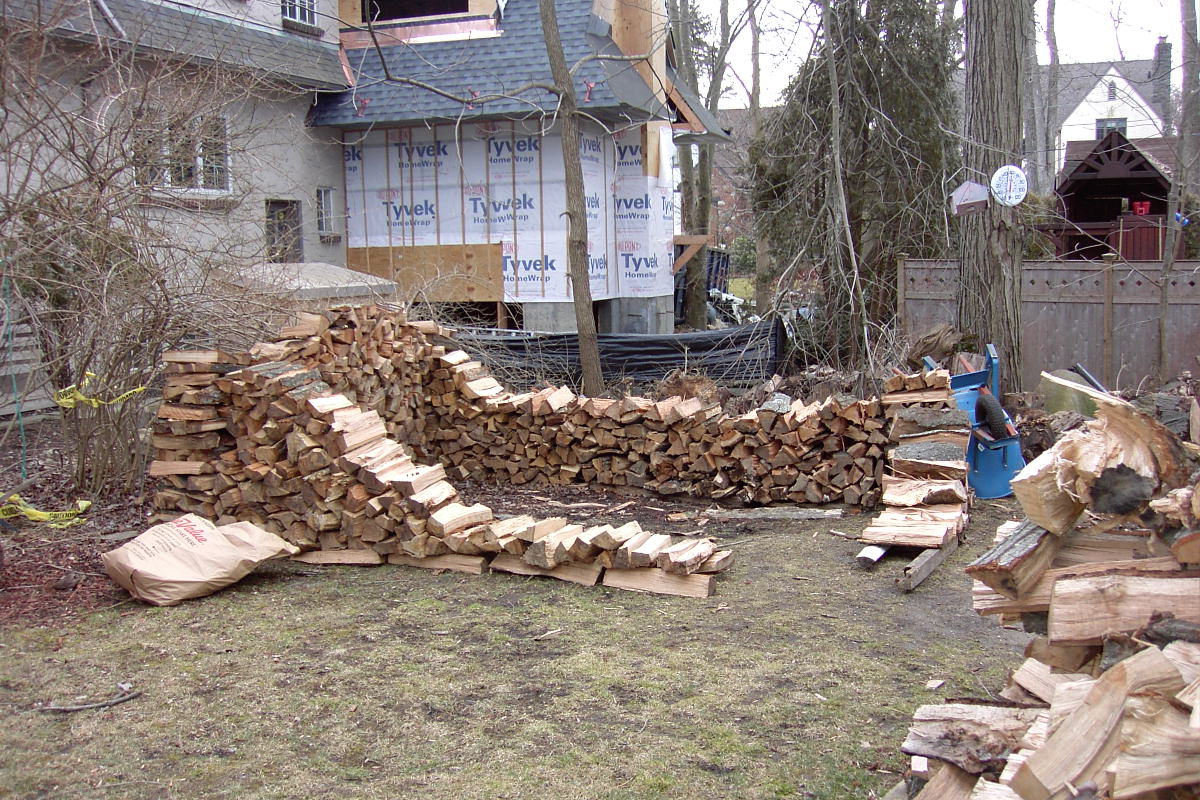
Here are some pictures of the tools that I use to split wood. These are the most frequently used tools by those who choose to do this by hand instead of using a wood splitting machine.
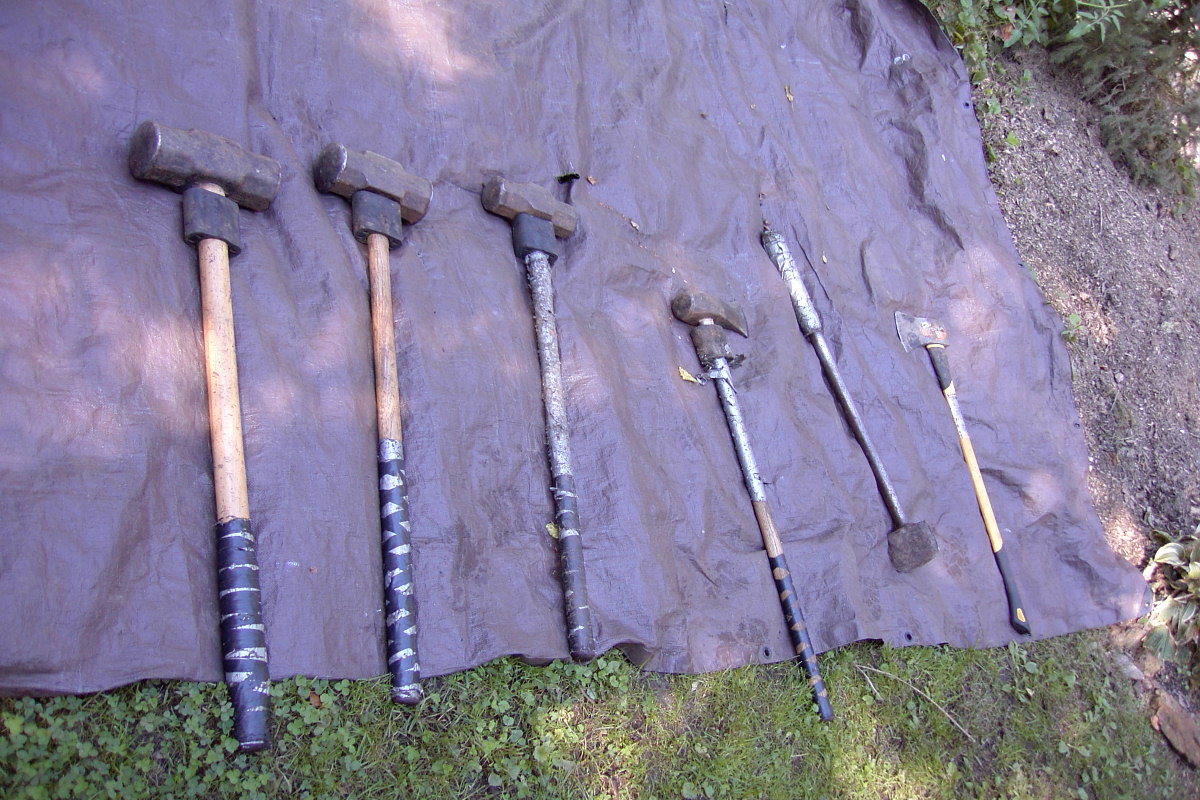
I have rather a large collection, since I have been doing this for several decades. I have a collection of sledgehammers ranging from small 12 pound one, for more “delicate work”; and a midsize 16 pound one that I usually use; and a 20 pound one that is used for particularly recalcitrant logs.
I have two mauls (a maul, as informed readers already know, is like a sledgehammer, only one end is sharp and is used for splitting.) The small maul is about 12 pounds and is the one I use most frequently. The larger one is 22 pounds and is sold under the brand name “monster maul” (although I can’t remember where I got it and I haven’t been able to find one even on the web for some time.) It used to have a hollow steel handle but, through my own misuse, hammering it with a sledgehammer when it was embedded in a log, that broke off. I took it to a local machine shop and had solid steel 2 inch bar stock welded into the head. It has not broken since.
Notice that the handles of the sledgehammers and the mauls are wrapped with tape. This is done to give a better grip and, in the case of the monster maul which has a solid steel handle ,to give me a little cushioning when it slams into a big log.
By the way, you’ll notice the smaller maul is taped all the way up. That is because on a freezing winter day, after whacking a log with it, it split in a peculiar way. The split was almost the whole length of the handle and it split into two pieces. I bought a new handle, but before putting it in, I decided to fit the two split pieces together and tape it up and it has lasted for about a year. I thought it wouldn’t last a day.
This brings up another point. Although I am pretty good at hitting a wedge with a sledge, in the past, and occasionally still, I miss. If you overreach, i.e. the steel head of the sledgehammer goes beyond the wedge, so the wooden handle strikes the wedge, the head of the sledgehammer will snap right off. This has happened to me many times over the years and as a result, I have a large collection of nice clubs at home ,which I never meant to have. You’ll notice, right at the end of the handle just before the steel head begins, a large lump of hard rubber called a “collar” which is designed to prevent this, and actually does a pretty good job.
I previously wrote about developing rotator cuff problems which resulted from spending too long at any one time swinging my tools, three or four hours. Also, I think it was because I was excessively using the 20 pound sledge and the 22 pound monster maul. It was just too much wear and tear on an aging shoulder. I now try to limit my use of the heavier tools to logs with lots of knots that really need it. Most of my splitting is with the smaller maul and a 16 pound sledge hammer.
You also see my selection of wedges. You may wonder why so many. Two reasons: first, like a surgeon choosing the right device, I use different wedges for different purposes. For example, that round one which I think is called a “grenade”, is used by me when a log is almost split open and needs to be finally blasted apart. Is relatively useless, I have found, when used alone to start a split, except for a very small log, perhaps 6 inches in diameter or less.
The second reason for so many wedges is that they are necessary when splitting a log which comes from that section of the tree where there are several large limbs branching out from the trunk, usually at the top of the long straight trunk of a tree where the first very large branches spread out. These kind of logs are extremely difficult to split and present a real challenge and a lot of fun for someone who is doing it for pleasure. For someone who is splitting wood to cook or heat the house, they are a real pain in the neck. A normal 2′ x 18″ log can be polished off in 5 or 6 minutes with a few wedges and a sledgehammer. By contrast, I have spent an hour or more on a giant log with several large branches.
Here is the problem, you put in 3,4 or 7 wedges, driving them in all the way and, no splitting takes place. Here’s where it gets interesting. You have to look for fault lines, rely upon a lot of experience and some intuition in placing the wedges. Some years ago I got 13 wedges impacted in a huge log and had to go off to a hardware store to get several more or those 13 wedges would still be there. Pictured are 14 wedges. I actually have 5 more at home, but I don’t usually take them out with me since I don’t usually encounter extremely challenging logs.
Now let me put in some pictures of these tools. This first one will be all the sledges and mauls, and, oh yes, I forgot there is also an axe. That is used for particularly fiberous logs when they’re almost split apart just to cut the final connecting fibers.
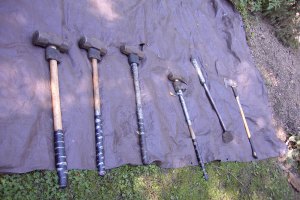
All the tools
This brings up another point. People are always asking me if I’m still “chopping wood”. Being a purist, I am offended, of course, but I don’t bother to correct them and tell them that the proper term is “splitting wood”. It is only possible to split very small logs with an axe. An axe was used to cut down trees in the old days before chainsaws (and is still used by fellows like myself whose wife does not allow him to use chainsaws any more just because of one tiny accident.)
The next picture is of the three sledges. When there are little kids around, for example if I am building a wood house for them, I explain that the little 12 pound sledge is the baby sledge, and a 16 pound sledge is the mommy sledge, and then I pause. Invariably they will chime in and say that the big 20 pound sledge is the big daddy sledge, and they are right, of course.
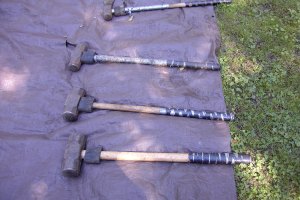
The “little family” of sledges
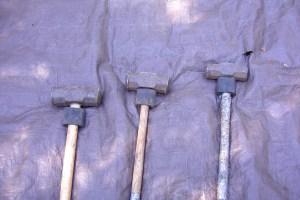
- Another view of the little family
Now for a picture of the small maul, with its grevious wound, all taped up:
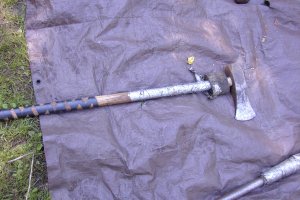
Small maul
And now for the monster maul:

The monster maul
by the way, I don’t think you can see it in this picture but the monster maul is not sharp at all. Indeed, it is about three eighths of an inch wide at the “sharp” end of the wedge. I think I sharpened it once, many years ago, to be about a sixteenth of an inch wide, but is a lot of metal and takes a lot of sharpening. It doesn’t make any difference. It is the weight and momentum that splits the woos. When that 22 pounds of steel comes smashing down on a log, it does not have to be sharp.
Here is a picture of a nice selection of wedges
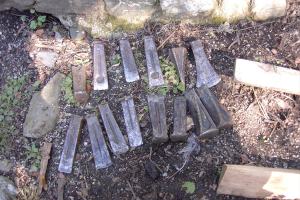
- Wedges
Well that’s about all I can say, and all one needs to know about wood splitting tools.

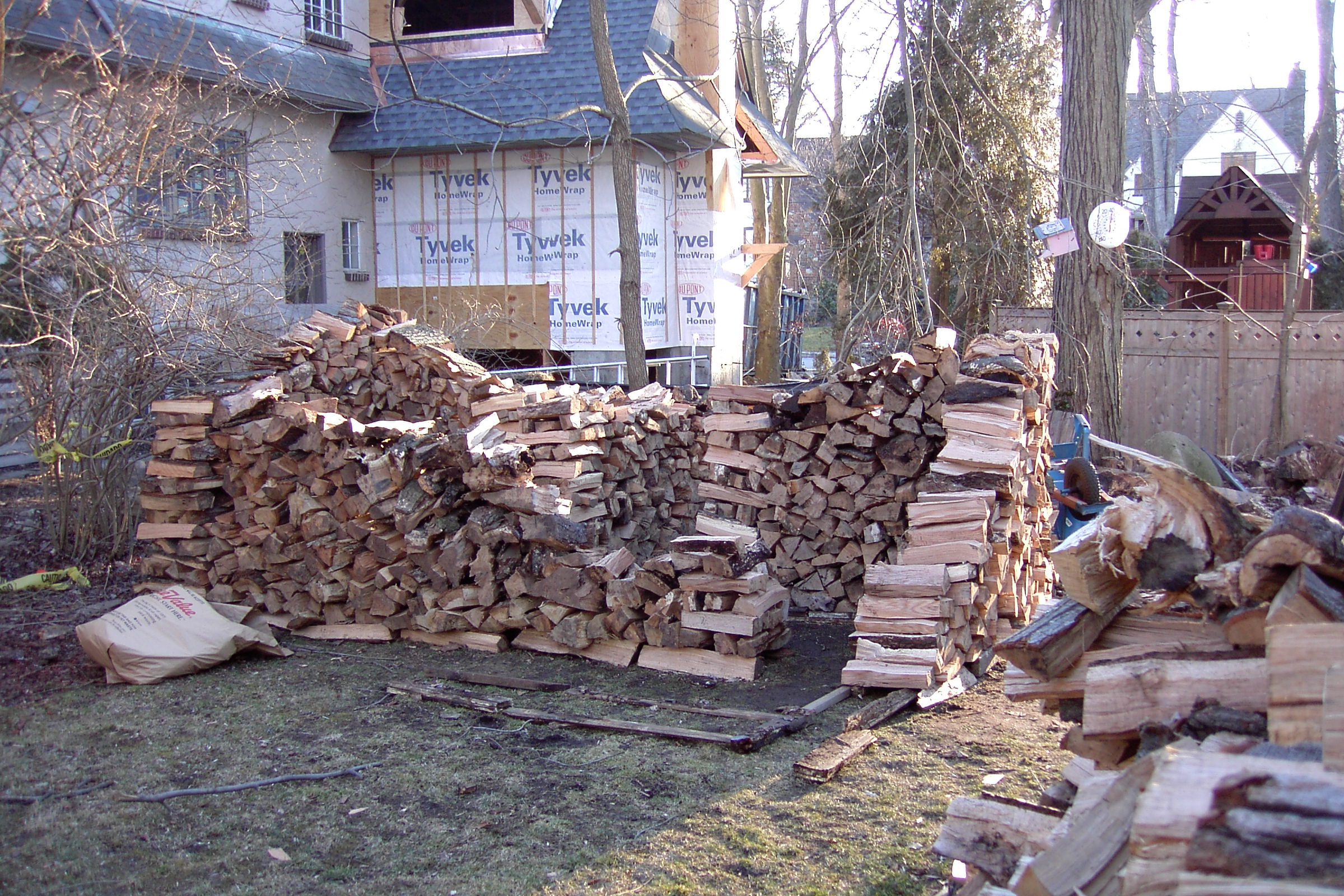
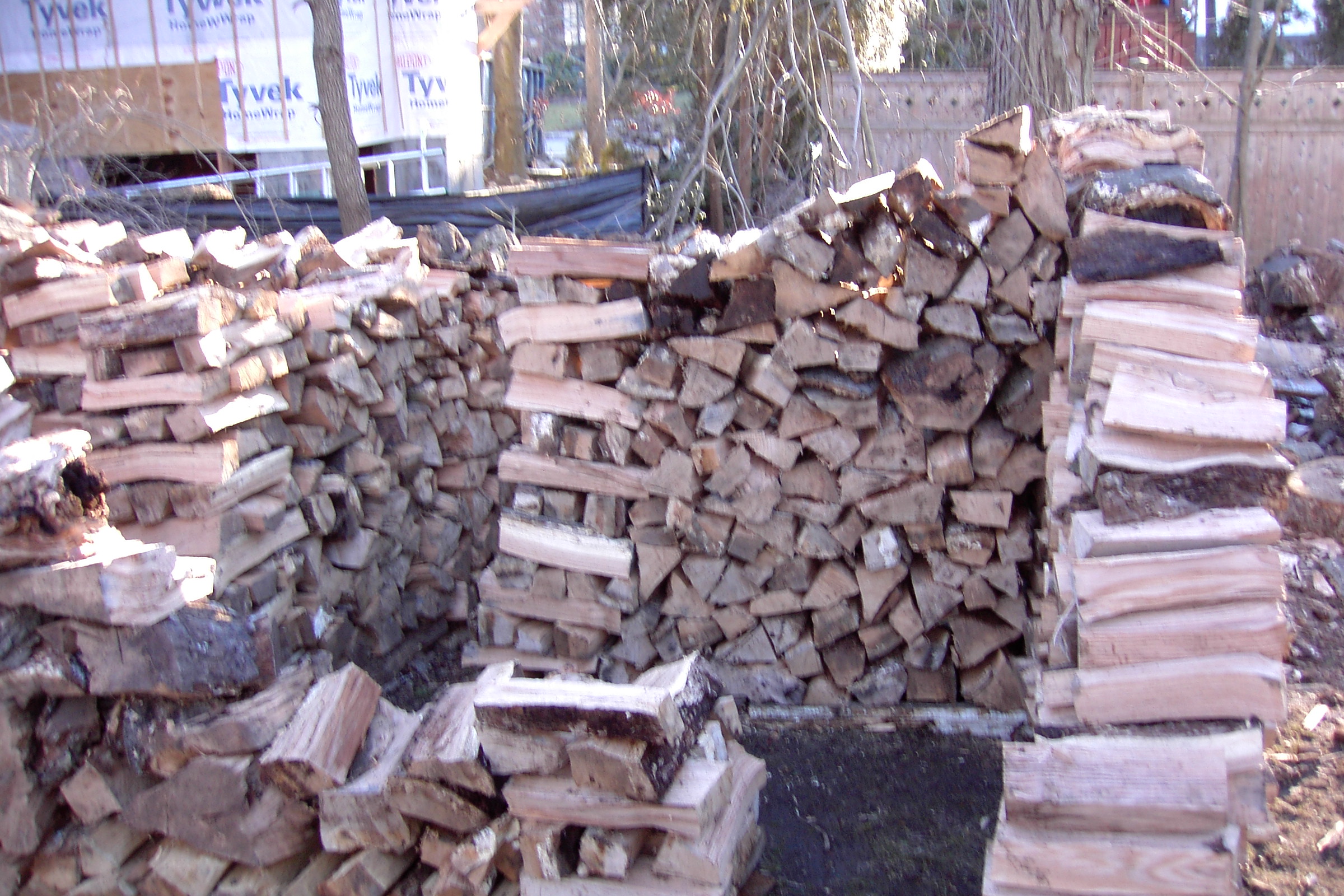

















 Woodsplitting Tips with Robert Borsody